Showing posts with label Moog. Show all posts

Saturday, April 26, 2014

The “New” Emerson Moog Modular System


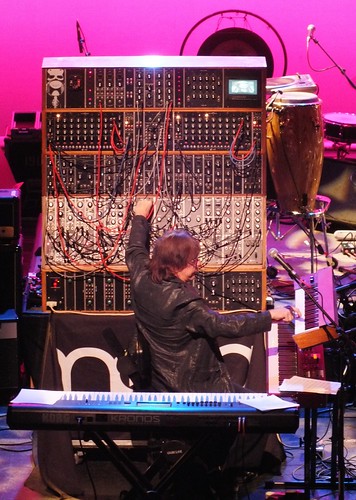
Moogfest 2014 Keith Emerson

In some astounding news, well, at least for synth geeks, Moog has announced they’re making a new modular synthesizer. In a sense it’s not new as they’re apparently built-by-hand recreations of Keith Emerson’s giant custom modular system, for which he is justifiably famous. There are so many things which are just so unbelievably cool about Moog’s announcement though that when I first heard I was reduced to fits of giggles at their sheer audacity. The best part of all of this, aside from the fact that they’re doing it in the first place, is that they first announced they were making modulars again on April Fool’s Day. Now that was sheer marketing genius, and they “got” us all. Everyone’s been asking for years when Moog would make a modular, since after all that was how the company originally became known. So for them to announce on their web site on April Fool’s Day that they were making a modular, which was so obviously untrue since it was April Fool’s, was both hilarious and bittersweet. But to have it actually be true, well, they just totally punked us all! An actually true announcement that nobody on the planet would believe; I can’t imagine a better April Fool’s prank than that.

Seriously, I’ll try to stop gushing. I promise.

Perhaps a little (vastly abbreviated) history is in order. Moog (the person, not the company) originally made theremin kits. Without actually looking things up to get the dates right, and also greatly over-simplifying it all, when Bob Moog was in high school he had a home business making the early electronic instruments, I think since the 1950s. In the ’60s, as an engineer, he had the idea of controlling sound circuits using external voltages rather than by turning knobs, and from that one simple idea modern electronic music was born. So instead of altering the pitch, volume, or tone of a sound by hand, you could use voltages from somewhere else to control those parameters. Working with several musicians, Moog developed the various electronic synthesizer modules we take for granted today. Over a number of years the modules were “perfected,” and you could buy them in any combination you cared to. You’d give them your list of modules and they’d build them into some wooden cases for you. Except when I say “you could buy them” that’s totally not true because it was rather frightfully expensive. So Moog took his module ideas and built them into a smaller, hard-wired instrument. It wasn’t the big Moog patchable modular, but rather a small Moog non-modular. A Minimoog, if you will. And the rest is history, and electronic music took over the world. (Again, please excuse the somewhat large rather monstrous oversimplifications.)

So in the beginning, there was the giant Moog modular, and that’s how I and the rest of the world first heard of synthesizers. Not only did they sound weird (and cool) but they looked weird (and cool) as well. In a time when the electric guitar was still a new-ish thing, who would have thought a bookcase full of weird scientist electronics could be a musical instrument? But oh, it was. On record it was Wendy Carlos and Switched On Bach that showed us how, but in concert it was Keith Emerson using his giant modular synth for live rock ’n’ roll night after night that turned the world onto synthesizers. Rick Wakeman toured with perhaps half a dozen Minimoogs, which in itself was an amazing thing at the time, but it was Emerson’s giant modular that was perhaps what people thought of when they imagined a synthesizer. The Beatles had one, and the Monkees had one, but neither used them in public. Tangerine Dream famously toured with many modulars for many years but their music wasn’t something you heard on the radio so it was far less well known to the public (although it’s in perhaps dozens of movies, many of which you’ve seen). In popular culture, though, it was Emerson’s Moog modular you always thought of. 

And now Moog has announced they’re going to be making them again. Not many, and not cheap, and by hand rather than on an assembly line. They’re going to be more or less an exact recreation of Emerson’s. Exact same parts, exact same assembly, exact same designs. Not a modern version of what he had, but pretty much exactly what he has. The only bad thing is they specifically state that Emerson’s rocket launchers will not be included. Total bummer. But then again, to be fair, no pyrotechnics modules were included from the factory in the original Moogs either. Definitely an aftermarket add-on.


Photo of Keith Emerson at Moogfest 2014 by John Grabowski, from his Flickr stream


Sunday, March 9, 2014

Moog exhibit at Rough Trade NYC in Brooklyn

Triple Moog racks
Went to the Moog exhibit this afternoon at Rough Trade NYC in Brooklyn. It was small but completely amazing. The exhibit was upstairs in a small room above the main entrance. They had five stations, each one with a huge rack of synths. Also, downstairs in the Main Drag Music area was another smaller space that was more store-like and more focused on the various Moogerfoogers. 

Honestly it’s a bit hard to decide what my favorite part was. It’s hard to deny the appeal of the triple rack “modular” wall filled with Voyagers and Moogerfoogers, but for me it really had to have been the polyphonic Phatty tower that was the highlight. 

There were maybe 10 Slim Phattys in the tower, all slaved to a single Little Phatty that controlled them. Now, I have a Little Phatty Tribute Edition, and have played Moogs since I got my first one in 1980. So I went up to it and just naturally started playing. It was totally cool that when you turned a knob on the controller the entire tower’s knob lights changed with it. But the weird thing was that I almost didn’t even think of playing more than the single note at once. I’ve been playing Moogs for so long and they’ve only been one note at a time, so I had to actually mentally make myself play more than one. But once I did that, well, I almost don’t even know how to describe it. It was sheer Moog synthesizer power under my hands, playing huge chords making monster sounds. Almost at a loss for words to describe how it felt. 

Moog Phatty tower
Once I tore myself away from the PolyPhatty tower there were a number of other stations in the room. One was a drum station with a six-Voyager tower of its own. Another was a guitar station with six Moogerfoogers and 20 Minifoogers. Yes, 20. If that’s not enough effects power for any guitarist, well, I just can’t help you. 

And because I had to get home in plenty of time for the first Cosmos episode I didn’t even have a chance to mess with the other stations. And that’s not even mentioning the theremin, or the downstairs section. So I think I’ll actually go back next weekend seeing as how it’s there for the whole month. I’ll get there when they open and set aside more time so I’ll be able to really work with the equipment, take some closeups, take a quick movie of the Slim Phatty’s lights moving in synchrony, and take enough photos to make a panorama. I actually tried an iPhone one but the walls weren’t far enough away to make it work, so I’m hoping my regular camera and some software will work better.

So, if you’re in the New York City area, I highly recommend a visit to Rough Trade NYC for this Moog exhibit. It’s small, but it’s totally packed with Moog synth technology. Heck, it’s worth going for the Moog pocket protector alone!

My Moog pocket protector!


Saturday, October 22, 2011

Animoog for iPad


So today was the first day I really sat down with Moog’s new Animoog app for the iPad. Not for any good reason, but I stayed up after midnight on the night of the announcement to see what it was about, and when I saw that it was only $1 (temporarily) it was basically a no-brainer. And for a few days after that I picked out presets and played with the knobs a bit and thought it was pretty cool. I even downloaded the manual. (Which I have now read. Twice.) And while there’s been a bit of controversy over their “First Professional Synth Designed for the iPad” tagline, I have to say that after spending some quality time with it I’m pretty much blown away.

At first I thought it would be a cool toy, but after using it for most of the afternoon today I’ve come to think of it as a “real” synthesizer and not just an iPad app. First off, it doesn’t just have a few waveforms. Instead it has 56 different “waves,” plus one silent one. They’re not static waves either but rather actually synthesized tones. It’s almost like they’ve taken an analog synthesizer and a wavetable synthesizer and made a mashup on the iPad.

But it goes further than that. They’ve done things with Animoog that you really couldn’t have done on an analog synth because the whole playing surface of it is touch sensitive, and the “keyboard” responds to multi-touch. It’s almost like they’ve taken a synthesizer keyboard and a Haken Continuum and formed them into a 2D synth controller that responds to poly-pressure. It’s actually strange that such a unique and interesting keyboard came out of Moog, but apparently Bob Moog made an actual physical keyboard like this for someone decades ago, and the Animoog keyboard is modeled after that. And the glass playing surface is perfect for it. You can play individual notes, and you can slide your fingers left to right to slide between notes. You can also slide up and down on a note to change the timbre of the tone as well. There’s a pitch correction control as well. Set all the way up makes each note discrete, set all the way down makes it slide evenly from note to note as if you were playing slide guitar. You can also set up the keyboard to play in a scale, either one of the preprogrammed ones or one of your own making.

In addition there are all the “standard” synthesizer elements such as a multi-mode filter, delay module, envelope generators (three of them), etc. Beyond that, there are things like four fully routable modulation paths. But what’s totally cool is that it’s four-voice polyphonic. When they said “professional synth” in their marketing copy I took it with a grain of salt, but after spending some time exploring the synth I have to say that it’s true. I might not have used their “first” bit, but the thing is an incredibly expressive instrument, and I can’t wait to finally hook up my iPad to a MIDI keyboard (although honestly I think I’m going to miss the on-screen keyboard because it’s just so good).

But in some ways all this, while nice, is not even the interesting part. What they’ve done is to add on an X/Y pad like they have on the Minimoog Voyager. The pad is divided into 8 vertical and 16 horizontal zones. The true power of the Animoog is that you can assign a different sound to each of the 8 vertical zones if you want to. You can then change timbres by moving your finger around the X/Y pad. Moving up and down changes between the 8 basic timbres you’ve chosen, and moving side to side changes some parameters of that zone’s sound. It’s hard to explain but simple to do. There’s a great animated image showing exactly what’s going on with the X-Y pad, and in this case a couple of images will save me a few hundred words at least.

But it goes beyond even this. The TRUE true power of the Animoog synth is that you can animate the X/Y pad in several ways. Notes you play on the keyboard are not static, but rather they move around the X/Y pad, and in doing so the timbre constantly changes as the note crosses the boundaries between zones in the 8 x 16 grid. But wait, there’s more. It’s not just that the notes move, it’s that you can draw a path that the moving notes will follow. It’s a simple idea, but that’s what makes this synth generate its unique sounds. While it’s certainly possible to make a static sound that just sits, there are so many elements of motion you can impart to your patches that it’s just hard to express in written words what this thing can do.

Oh, and did I mention the sound-on-sound recording module that has layering and overdubbing? Almost forgot.

So all marketing hyperbole aside, Animoog is an incredibly powerful synthesizer. And while I’m totally looking forward to getting an iPad/MIDI interface soon, 10 minutes with Animoog has made me wish I had a Continuum. And if someone out there decides to make a physical 2D flat surface keyboard I’d definitely consider plunking down some dollars just so I could use the Animoog synth to its full potential.

This is by no means a complete review of every feature the synth has to offer. It has a 9 page manual, but even though that doesn’t sound like much the Animoog has a tremendous amount of depth to it. I’ll try to record a few examples of what it can do over the next few days and post them here. And just to balance out my bubbling praise, there are a few rough edges. Like when “turning knobs” I’ve sometimes managed to hit the change module buttons in the middle of adjusting something. That’s probably my fault, but I’ve managed to do it a bunch of times. Many Mac software synths give you a choice between rotary or linear control of the knobs and I guess I’d prefer rotary. And I have to say that the way you save your patches is completely unintuitive and that’s being polite. It’s also barely mentioned in the manual. It’s not a huge deal as once you figure it out the first time (hold the Save button for an indeterminately long time and you’ll be OK) it’s easy enough to do. Another thing I’d like to see is sound banks. There’s only one, and while that’s fine I’d rather have the built-in bank separated from my own patches. And oh yeah, if you’re going to play live with this, make sure you turn off notifications unless you want to hear all those Words With Friends notification sounds while you’re playing. These are all pretty minor niggles, though. In case you couldn’t tell, I think this thing’s amazing.

Animoog for iPad, from Moog. The real price will be $30 in a month, but for now it’s only $1 (as is their Filtratron app as well). If I didn’t already have an iPad, this app would make me go out and buy one. It’s that good. This is the Moog polysynth I’ve been waiting for.

Update — here’s an Animoog tune I just did:


Wednesday, January 28, 2009

Patrick Moraz Live With Yes - 1974


Last week I received my copy of Yes Live at QPR (stands for Queens Park Rangers, for those of you who don’t follow English football). I have to say, it was both surprising and very satisfying. In my earlier post on Moraz and his double-keyboard Minimoog, I talked about how I was a teenager when Relayer came out. 35 years ago and that album still resonates with me, those silky smooth synth lines, which at the time and in fact only until just recently seemed rather mysterious since I had no idea what he used to produce them. A few weeks ago I found out he played Minimoogs. Once I knew that, I had to see video of him live, which is where YouTube is your friend. Many of those videos were from the DVD of the QPR show, so after a bit of searching I went out and bought it.

So, a couple of observations. One is that the DVD does not have the entire show. There’s a separate DVD of part two of the show, but I don’t have it yet. Two is that it’s not an official release. I’m not quite sure if it’s 100% bootleg, but it’s also not quite official either. There were more than a few sound quality issues with the recording, which a Wikipedia article claims were actual problems with the sound at the show. It sounded a little implausible to me, but after reading a number of reviews of the two DVDs on Amazon, there apparently were sound issues and it’s not just a poor recording. The reviews of the second disc say the sound got much better at that point, though. So if you’re looking for a flawless recording, this ain’t it, but if you’re looking for documentation of a great show and can deal with some sound quality issues in the first half, this is definitely for you.

But aside from all that, what I really wanted to talk about was the show. Even all these years later, all the way back from 1974, it’s a standout. One of the biggest surprises for me, actually, was that Jon Anderson played electric guitar for much of the show, as well as a bit of drums. Looking back on it with 20/20 hindsight, there’s of course no way they could have played Gates of Delirium without that extra guitar. I was honestly quite impressed. Anderson did a fine job adding a rhythm guitar to the song, and that allowed Steve Howe to have the freedom to let loose and play. It would have been a much harder job to recreate such a complex and involved song without Anderson’s help (and besides, it kind of gave him something to do through all those long instrumental passages). I’ve seen Anderson play, uh, somewhat cheesy acoustic folky guitar at any number of Yes shows over the years, but to see him A) play electric and B) actually really play it was darn impressive.


Perhaps, though, the most amusing aspect of the show was Chris Squire’s poodle boots (barely visible as an odd puffiness as Moraz crosses behind Squire). Now, it’s probably not fair to criticize 1974 fashions 35 years down the road, but still...To compensate for any hurt feelings my statement may bring up, I have to say that Squire’s Doctor Who-style coat was pretty cool. So Chris, if you’re reading this, please, no hard feelings about the boot thing, OK?

As far as equipment goes, Moraz had four Minimoogs. Two of those were “regular” ones, although one was black, and the other two were in his custom-made double-Mini. He also had an organ, with a Fender-Rhodes on top of the organ and one of his Moogs on top of that. That was on his right if he were facing the audience. On his left was a Mellotron and the double Minimoog. In front of him was the black Mini. Behind him I believe was a Clavinet, but I don’t recall him playing it in the video so I’m not sure. He also had a grand piano on the other end of the stage as well. Lastly, it looked like Alan White also had a Minimoog, but I didn’t see that one get played either so I’m not sure what he was doing with it.

I’ve seen Moraz live a few times, playing acoustic piano with Bill Bruford at the Bottom Line in New York City. It was a real treat, though, to see him go wild on a pile of synths, even if it was only on DVD.

Photos are single frames from the Yes Live at QPR Part 1 DVD.

Thursday, December 11, 2008

The Patrick Moraz Double Minimoog


It might take me a little while to get there, but give me a minute or two and I’ll make it. I promise.

It all started many years ago when I got Chris Squire’s solo album Fish out of Water. I’m a huge Squire fan, and I’ve always loved that album. The problem is, I only had it on vinyl so I couldn’t really play it anymore. I don’t really like re-buying the same albums again and again, except for a very few. (Some notable exceptions are Close to the Edge, of which I have far too many copies, mostly because I kept wearing them out from playing the LPs so often when I was a lad, and also 2001, which sorta counts and sorta doesn’t because it’s both a book and a movie and I have several copies of each. But I digress. Although I -did- warn you of that at the beginning.)

Anyway, I’ve never really loved buying music from iTunes because of the DRM, although I’ve bought a good amount of music there over the years, so I’ve recently started to buy mp3s from Amazon’s music store. No DRM, which is actually rather refreshing (but I digress again). The beauty of this is that it’s actually pretty inexpensive for many older albums. I got Fish Out Of Water and The Lamb Lies Down On Broadway for US$14 for both of them together. That’s not a bad deal.

I’m getting there. Trust me.

The point of this is that I just about a week ago got Fish Out of Water, and while I certainly remembered the album, I had more or less forgotten that Patrick Moraz plays most of the synthesizers on it. It was almost a revelation. After the first time I listened to it, I almost immediately played the Relayer album. And that brings me to Moraz’s incredible synth sound. I’ve had Relayer since the early ’70s when it came out, but despite having played many synths in my time I was never sure how Moraz got that “liquidy” in-motion kind of joyful sound out of his synths. 

If you want to hear what I’m talking about, it’s in the middle of The Gates of Delirium, after the “war” section but before Soon, right after the drum bashing and right before Steve Howe’s slide guitar solo. The Moraz solo synth part comes in at 12:48 in the studio recording. It’s like he’s got a slow sweeping LFO on the cutoff frequency at the same time that he’s got a much faster frequency modulation going on for vibrato (which maybe he did with the pitch bend wheel). Incredible technique.

I was just a little too young to have seen him with Yes, being only around 13 or so when he was with them. I’ve seen him play with Bill Bruford several times on their piano and drums tours, though, so I don’t feel deprived too much. But ever since I got Relayer I’ve always wondered what he used to get those sounds.

So naturally, in order to find out I turned to the Analog Heaven mailing list, where I enjoyed a good discussion with several people who were there at some of those early ’70s Yes shows, and where I was also directed to various YouTube videos. It turns out that Moraz played a pile of Minimoogs! I was completely surprised when I found this out. I actually own four Moogs—two Minis, one a Model D and one a Voyager, a Little Phatty and a Multimoog. I would never have guessed in a million years that Moraz was playing a Minimoog. I’m going to have to try a few things now, such as a Harmonizer or my Moogerfooger phase shifter, to see if I can get something approaching that incredible sound. It just doesn’t sound like a Minimoog to me.

I’m almost there. I promise.

So, in my research I was directed to the Yes show at Queens Park, where I saw him playing some kind of odd keyboard thing that could do two notes at once. Not the one he played for the solo mentioned above, but a different one on the side facing the drums. Unfortunately, the only decent shot of it was from below him. You could only see that he was using both hands, but not what the instrument was. I couldn’t for the life of me think of a black duophonic synthesizer that existed at around that time. And now that brings me to the Cantos Music Foundation. Unbelievable! They actually have the very instrument Moraz was playing in the video. And guess what? It’s a Minimoog also! Apparently Moraz had the some custom work done on two Minis, one black and one natural wood. They took the electronics section out of one and the keyboard out of the other and swapped them, putting the electronics into the space the keyboard one occupied and vice versa. He ended up with a dual keyboard in one case and a dual Minimoog in the other, and those two-note synth lines I was hearing was Moraz playing both keyboards at once. In fact, you can see him doing that but using only one hand at times, leaving his other hand free to play something else. Another incredibly innovative technique and a sound that’s very hard to duplicate.

I feel like I’ve learned a lot this week. I’ve talked to a lot of people on the AH list, seen a lot of videos, and been to more than a few web sites. I was hoping to find a good photo taken from the audience so I could see exactly what Moraz was playing, but finding the Cantos Foundation photos was a huge stroke of luck. I’ve been to their web site before, and I’ve actually seen that photo before as well, but I never really made the connection between those early Minimoog photos and Patrick Moraz. True serendipity. I don’t often find myself in Calgary, but the next time I do I’ll be sure to drop by so I can see some of their amazing instruments in person.

Photo, number 79, used with the kind permission of the Cantos Music Foundation