Sunday, March 9, 2014

Moog exhibit at Rough Trade NYC in Brooklyn

Triple Moog racks
Went to the Moog exhibit this afternoon at Rough Trade NYC in Brooklyn. It was small but completely amazing. The exhibit was upstairs in a small room above the main entrance. They had five stations, each one with a huge rack of synths. Also, downstairs in the Main Drag Music area was another smaller space that was more store-like and more focused on the various Moogerfoogers. 

Honestly it’s a bit hard to decide what my favorite part was. It’s hard to deny the appeal of the triple rack “modular” wall filled with Voyagers and Moogerfoogers, but for me it really had to have been the polyphonic Phatty tower that was the highlight. 

There were maybe 10 Slim Phattys in the tower, all slaved to a single Little Phatty that controlled them. Now, I have a Little Phatty Tribute Edition, and have played Moogs since I got my first one in 1980. So I went up to it and just naturally started playing. It was totally cool that when you turned a knob on the controller the entire tower’s knob lights changed with it. But the weird thing was that I almost didn’t even think of playing more than the single note at once. I’ve been playing Moogs for so long and they’ve only been one note at a time, so I had to actually mentally make myself play more than one. But once I did that, well, I almost don’t even know how to describe it. It was sheer Moog synthesizer power under my hands, playing huge chords making monster sounds. Almost at a loss for words to describe how it felt. 

Moog Phatty tower
Once I tore myself away from the PolyPhatty tower there were a number of other stations in the room. One was a drum station with a six-Voyager tower of its own. Another was a guitar station with six Moogerfoogers and 20 Minifoogers. Yes, 20. If that’s not enough effects power for any guitarist, well, I just can’t help you. 

And because I had to get home in plenty of time for the first Cosmos episode I didn’t even have a chance to mess with the other stations. And that’s not even mentioning the theremin, or the downstairs section. So I think I’ll actually go back next weekend seeing as how it’s there for the whole month. I’ll get there when they open and set aside more time so I’ll be able to really work with the equipment, take some closeups, take a quick movie of the Slim Phatty’s lights moving in synchrony, and take enough photos to make a panorama. I actually tried an iPhone one but the walls weren’t far enough away to make it work, so I’m hoping my regular camera and some software will work better.

So, if you’re in the New York City area, I highly recommend a visit to Rough Trade NYC for this Moog exhibit. It’s small, but it’s totally packed with Moog synth technology. Heck, it’s worth going for the Moog pocket protector alone!

My Moog pocket protector!


Sunday, September 8, 2013

Arthur C. Clarke and The Colors Of Infinity

Arthur C. Clarke


Just had my mind blown by Arthur C. Clarke. Yet again. Somewhere, through a chain of Twitter retweets, I came across a link to a 1995 TV program he did called Fractals: The Colors Of Infinity. In just under an hour it seems I had pretty much all my favorite things—Clarke, science/math, technologyall accompanied by a soundtrack from David Gilmour. Not sure how I could ask for anything more in a single TV show.

So this post doesn’t have much to do with synthesizers per se, although the soundtrack is excellent. And I’m certainly no mathematician or scientist either. It’s just that Clarke’s books, 2001 in particular, have been a huge influence on me. The movie came out when I was 8 or 9 years old, in 1968 or ’69, and I remember my sister taking me to see it at the Ziegfield Theater in New York. We sat in the front row so we could lie on the floor under the screen at the appropriate moments. It’s possible that it may not have been when it first came out as the Ziegfield used to bring it back seemingly every year for quite a while, but I was definitely a little kid. Old enough to think it was really weird to lie down in the front of a theater but young enough to still go ahead and do it.

But the point about Clarke is that his books and his vision of the future shaped me. No one else in my family was into technology and science the way I was, and his books pointed me that way at a very young age. And the movie version of 2001 was so mind-blowing, at that age, that I couldn’t help but have it be a major influence. It had space ships and science and psychedelia all woven together, along with a huge dose of mystery as well as an incredible score chock full of classical music. That movie was such an influence on my young personality, and that it came at more or less the same time as the moon landings, helpfully “narrated” by Clarke and Cronkite of course, certainly didn’t hurt. Spaceships floating serenely by as if it were just a regular thing, investigating objects near Jupiter not made by humans, all accompanied by two pieces of the creepiest-to-a-nine-year-old music of all time—Atmosphères and Requiem by György Ligeti. 2001 was such a huge influence on me in many ways, and those two pieces of music are possibly where I first got my love of pure texture. They were terrifying, yet also exhilarating.

And just about at the same time, the Moog synthesizer was unleashed upon an unsuspecting public. My fate was sealed.

So in a way I grew up with Arthur C. Clarke, and with math and science, and also with David Gilmour’s music too I suppose. And they all come together in this fractals program from the ’90s. Well worth an hour if you’re so inclined.

Fractals: The Colors Of Infinity

Requiem

Atmospheres

Photograph: ©Andrew Holbrooke/Corbis

Thursday, September 5, 2013

Hesitation Marks - Nine Inch Nails

Nine Inch Nails - Hesitation Marks

Great album. Not quite what I expected in some ways though. Not at all in a bad way, it’s just that having seen the live streams of various recent performances I was expecting a much rowdier album in a way. I guess I was expecting Nine Inch Nails, and what I got was some kind of cross between the Cure, How To Destroy Angels, Tangerine Dream, and NIN. Which I have to say from my perspective is totally cool.

So first thing I have to say is that when I heard Adrian Belew was part of the new Nine Inch Nails I was totally blown away. Couldn’t have imagined a better combination. Then some months later that was that and it was as if it had never happened. I was a little bummed in fact. So I was pleasantly surprised to see that he’s actually all over the album, and that made me pretty happy. Perhaps not front and center like it was King Crimson, but he’s definitely there. Nice.

Secondly, you can hear a huge bit of How To Destroy Angels. Far less wall of guitars, at least on the recording, and far more wall of synthesizers. Again, from my perspective, totally cool. It’s less hard rock and good bit more interesting. There’s a lot of texture here, a lot of arpeggiator and sequencer, not near as much bit-mangled guitar. In some ways there’s a lot more here, and a lot more room to breathe, more room for the music.

And yet it’s still Nine Inch Nails. Still the same power, the same raw emotion, the same edge. And live, with the same huge crazy energy. So as a huge How To Destroy Angels fan and a huge Nine Inch Nails fan and a huge Trent Reznor soundtrack fan I have to say that Hesitation Marks is a darn good blend of all of those. And hey, it’s even got a little saxophone. Can’t ask for more than that.

I’m seeing them live in a month or so with 20,000 or so of my closest friends at the Barclay Center in Brooklyn, my first time there. Can’t wait.

Saturday, July 20, 2013

Blueneck - Epilogue

Blueneck. Not a new band, but one I'd not heard of before. And thanks to @ClassicRockProg, who mentioned in a tweet that the band is giving away their most recent album, Epilogue, for free (but not for much longer) I've now become a fan. So much so that I've gone back and paid for my free album.

Blueneck album coverEpilogue: short and sweet, eight songs, half an hour long. But each and every song is filled with atmosphere. I always describe what I do as textures, full of synthesizers creating rhythm and, well, texture, through careful building, blending, and layering. What Blueneck does on Epilogue though is atmosphere. Starting from the simple piano line of the opening track, Apogee, what they do is create atmosphere rather than building texture. It starts simple, and it stays simple, but somehow by the end you're swept away in lush beauty that you never noticed until you find yourself in the middle of it. 

So Epilogue is nothing at all like what I do, but at the same time it's exactly what I do. It's as if we've taken two completely different paths yet ended up at the same place, or at least very similar places. Epilogue feels like something I might have written and recorded, except after Brian Eno got his hands on it in the studio. Quiet yet loud, slow yet fast, rock and roll yet symphonic. I've had it three days, and played it over and over.

No idea what they're other albums are like, but give me a little time and I'll find out as you can stream them all freely on their bandcamp page. And they're also touring if you're in Europe. 

I guess I'll keep this short and sweet as I pretty much know nothing about the band. They do have a web site with a brief bio, but somewhat amusingly it's only a single paragraph in which they call themselves post-rock and leave it at that.

So, Blueneck. Their album Epilogue is a free download but only until July 21 maybe. Highly recommended. 


Tuesday, November 20, 2012

Roger Dean - Dragon's Dream iOS game


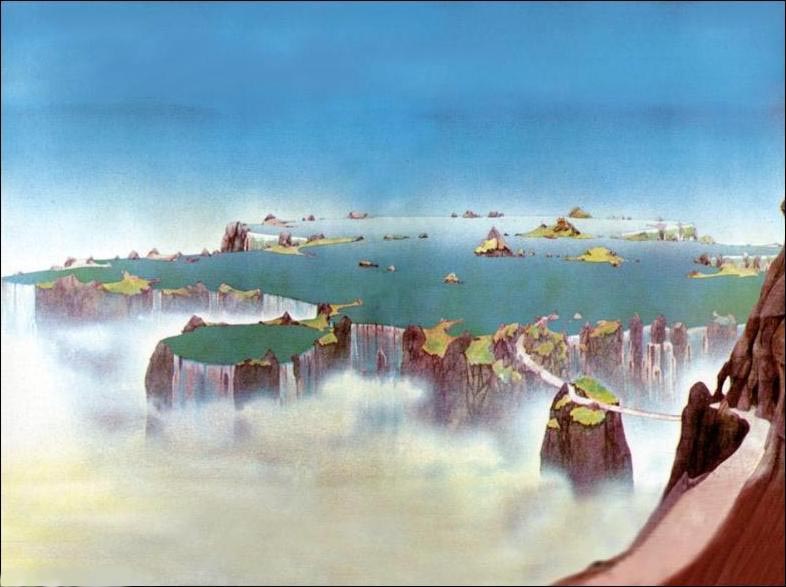
Got home from work today, went online, and thanks to The Verge of all places found out there was an iPhone/iPad game out from Roger Dean. Who knew?! For all you youngsters out there Roger Dean made many famous album covers back in the ’70s and ’80s, most notably for Yes (not to mention designing their logo). His incredible technique with the airbrush let him create wondrous paintings for dozens of prog albums from that era. 

Yes logo


I’ve worn many of his designs on t-shirts over the years, and I’ve always wanted to build a Roger Dean house (with badgers in the basement) and have Roger Dean furniture in my (regular) house. I could write a whole article on his paintings and how they influenced my musical direction, but this is about his iOS game.

The app basically has three parts. There’s the art of course, there’s music, and there’s the actual game. In a way the art elements need no explanation. It’s all Roger Dean paintings. The music surprised me a bit to be honest. I was expecting boring game music, but it’s actually somewhat interesting. I haven’t played the game for hours on end, but the pieces I’ve heard so far have been pretty good, sort of “prog lite” in a way. Not elevator music at all, but a synth-heavy and not overly simple bit of game music. Definitely background to the game, but good in its own right. And the game? It’s fun. I’m not a gamer with lightning-fast twitch reflexes, so I guess I’m what’s known as a casual gamer. Dragon's Dream is easy to play and it’s fun. You’re basically flying a dragon around avoiding obstacles and picking up objects. Not a revolutionary concept, but a good solid side scroller. 


As you play you get rewarded by unlocking images you can use as backgrounds on your device, which is cool as they're Roger Dean paintings. So far I’ve gotten two of the seven without too much effort. I’m hoping the others are equally reachable as so far I’ve not gotten a score better than an E. I’m hoping that stands for “excellent” but I have a funny feeling that it’s really only the tiniest bit better than an F. Told you I wasn’t a gamer. 

I’m not sure Dragon’s Dream will set the gaming world on fire, but it’s only US$5. If you’re a Roger Dean fan, as I am, it’s pretty much worth it though.